Short answer: In Perth, a small bitewing x-ray typically costs $40–$90 per image (often $60–$120 for the two-image set taken at a check-up), a full-mouth OPG panoramic scan is usually $90–$180, and a 3D CBCT scan is generally $150–$450 depending on the area scanned. These are guide ranges only your dentist gives you a written quote after an exam, and most extras policies put some money back under general dental.
What's the difference between a bitewing, an OPG and a CBCT?
Each scan answers a different clinical question, which is why dentists don't order the biggest one by default.
A bitewing is the small image taken in the chair, usually two at a time, biting down on a little tab. It shows the contact points between your back teeth exactly where decay hides between teeth and under old fillings, where a mirror and light can't see.
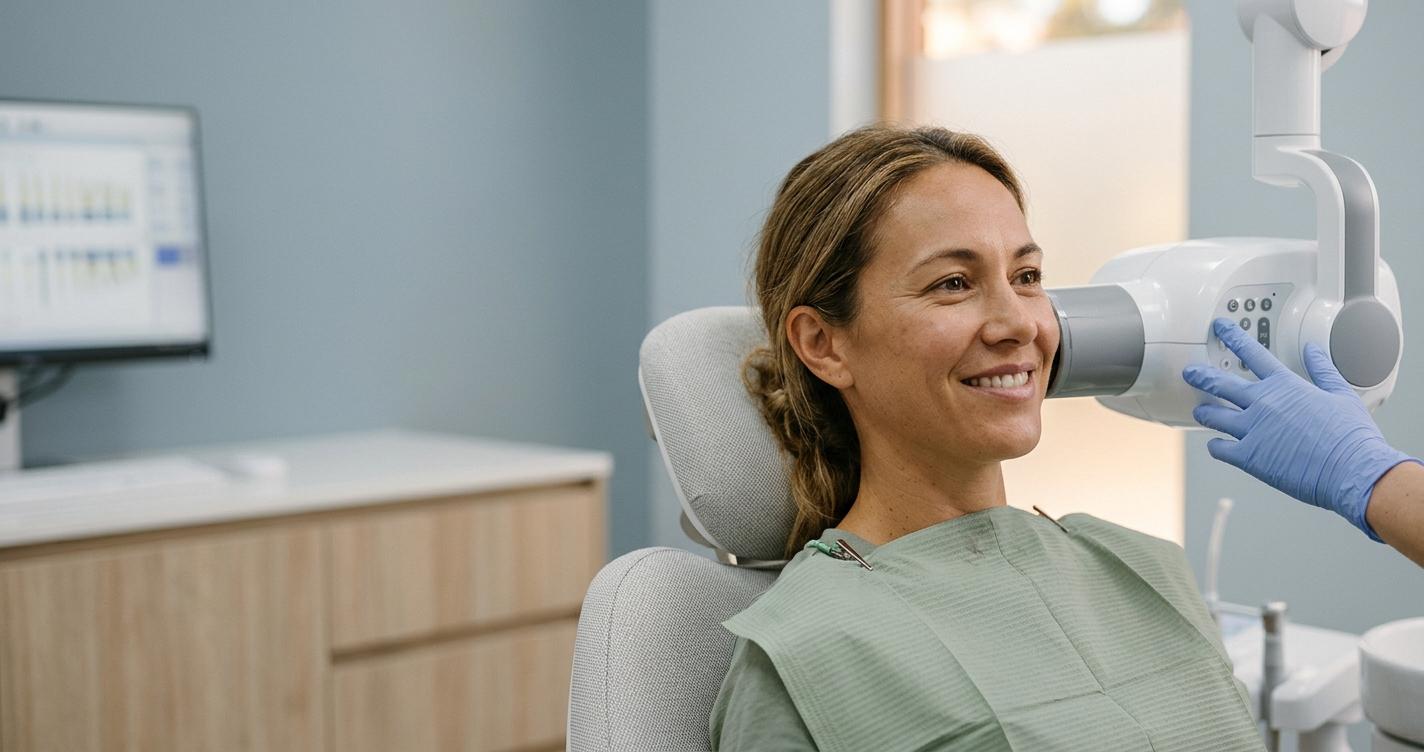
An OPG (orthopantomogram) is the wide panoramic shot that rotates around your head and captures both jaws, all your teeth, and the jaw joints on one image. An OPG is a wide-view dental X-ray that captures the upper jaw, lower jaw, all teeth, and surrounding structures on a single image, showing a flattened, half-circle view from ear to ear, covering the entire dentition along with the jaw and TMJ. It's the scan used before wisdom tooth removal, orthodontics and implant planning, or when a dentist needs the bigger picture rather than detail on one or two teeth.
A CBCT (cone beam CT) is a 3D scan. For implant planning specifically, a CBCT may follow the OPG to provide precise 3D bone measurements. It's reserved for cases where a flat 2D image genuinely isn't enough measuring bone before an implant, mapping complex root canal anatomy, or investigating something an OPG has flagged but can't fully explain.
If you want the radiation side of this answered properly, we've covered it in detail separately rather than repeating it here see are dental X-rays safe. The short version: digital dental x-rays use a very low dose, and your dentist only orders one when it will actually change what they recommend.
How much does a bitewing x-ray cost in Perth?
A single bitewing image is generally priced somewhere between $40 and $90, and most check-ups that include x-rays take two at once, so budget $60–$120 for the pair. Clinics outside WA have published figures in a similar band one Canberra practice lists an intraoral radiograph (bitewing or periapical) at $45.00 each while a combined check-up, clean and bitewing package nationally has been quoted at $200-$350 all in. Bitewings are almost always done in-house, in the dental chair, with no referral needed.
This is usually bundled into a check-up and clean rather than charged as a stand-alone item, so ask your dentist whether the quote you've been given includes x-rays or not before comparing prices.
How much does an OPG panoramic x-ray cost in Perth?
An OPG panoramic scan generally sits between $90 and $180 when taken at a dental practice that owns the equipment. OPG scan cost in Australia typically ranges from $90–$150 at a dental practice, with some radiology centres bulk-billing eligible Medicare patients. Not every dental clinic has its own OPG machine not all practices have an OPG machine, so you may be referred to a radiologist, where you might be able to claim the costs on Medicare. If you're sent to a radiology practice on referral for a straightforward diagnostic OPG, it can sometimes be bulk-billed or claimed through Medicare rather than paid for privately; implant-planning and more involved referrals are less likely to qualify. Either way, you'll get a written cost (or confirmation it's bulk-billed) before the scan goes ahead.
How much does a CBCT scan cost in Perth?
CBCT is the most expensive of the three because of the equipment and the 3D processing involved. Perth pricing generally runs $150–$450 depending on how much of the jaw needs scanning a small, single-area scan sits at the lower end, while a larger field of view costs more. A CBCT scan (3D X-ray) maps your bone density and shows exactly where an implant can go, and it costs $200 to $350 as a standalone item. Some Perth providers quote a slightly wider band of $150 to $500, so the exact figure depends on the field of view and whether a radiologist's report is bundled in.
CBCT isn't something every dental clinic has in-house. It's commonly done at a dedicated imaging or radiology practice on referral, and the fee quoted there is separate from your dental consultation fee. If a CBCT is relevant to your treatment say, an implant or a complex extraction covered in our guide to impacted wisdom teeth removal your dentist will explain why it's recommended and where it's done before you book it.
How often do you actually need dental x-rays?
There's no single rule it depends on your decay risk, your gum health and what's being planned.
For routine bitewings, bitewing X-rays are usually taken every one to two years for adults with a low decay risk, and more often if your risk is higher. If you have a history of fillings, gum disease, or a dry mouth, your dentist may want them yearly instead.
For a panoramic OPG, there's far less frequency pressure. There is no fixed schedule for panoramic X-rays the way there is for bitewing X-rays. An OPG is ordered when there is a specific clinical reason, not on a routine annual basis, and most patients who are not undergoing active treatment have one every three to five years, or when a new clinical question arises. Children having their adult teeth come through, or anyone starting orthodontic treatment, are common exceptions to that longer gap.
CBCT sits at the other end of the scale again it's typically a one-off scan for a specific treatment (an implant, a complex root canal) rather than something repeated on a schedule, though implant patients on long-term maintenance sometimes have a follow-up scan every couple of years to check bone around the implant.
What do health funds give back on dental x-rays?
Dental x-rays sit under general dental (sometimes called "preventive" or "diagnostic") on most extras policies, alongside check-ups and cleans. Most extras policies cover preventive dentistry examinations, cleans, X-rays and fluoride at somewhere between 60% and 100%, up to an annual limit. Diagnostic dental X-rays are covered under general dental benefits in most extras policies, and the number of claimable X-rays per year varies by fund and policy tier.
A few practical points worth checking with your fund before you book:
Confirm whether bitewings, OPG and CBCT are all classed under general dental, or whether your fund treats CBCT differently (some do, given the higher cost).
Ask how many x-rays per calendar year your policy covers before you start paying the gap yourself.
If you're referred to a radiology practice for an OPG or CBCT, check whether that claim goes through your health fund, Medicare, or is paid privately it depends on the referral reason.
The Australian Dental Association's national fee survey is the standard reference clinics and funds use to benchmark pricing, and it reports that dental fees have increased modestly over the past two years, reflecting challenging business conditions including lasting effects of the COVID-19 pandemic. That's useful context for why quotes vary clinic to clinic and year to year but a written quote after your own exam is always the number that matters, not a national average.
If you're weighing up x-ray costs against other treatment you might need, our broader guide to dental costs in Perth for 2026 covers fillings, crowns and extractions in the same format.
Where to get digital X-rays in Perth
Mullaloo Beach Dental offers digital X-rays as part of routine care, which means lower radiation exposure and an image your dentist can review with you on screen the same visit, rather than waiting on film. The practice also offers same-day emergency dental care, so if you're in pain and need a bitewing or a quick check to work out what's going on, you don't have to wait weeks for an appointment. If your situation calls for a full-mouth OPG or a 3D CBCT scan, your dentist will talk you through whether that's done on site or via a referral to a radiology practice, and what it's likely to cost before you go ahead.
You can see more about the practice's approach to digital dentistry and what's included in a standard check-up and clean, or look up the clinic directly on the Mullaloo Beach clinic page. Every price mentioned here is a guide your dentist will confirm the exact fee and your fund's rebate after an exam, in writing, before any scan goes ahead.
Ready to get a written quote for your x-ray or check-up? Book an appointment and bring your health fund card along.
FAQs
What is an OPG in dental terms? OPG stands for orthopantomogram a panoramic x-ray taken by a machine that rotates around your head, capturing both jaws, all your teeth and the jaw joints in one wide image. It's a panoramic or wide view x-ray of the lower face, which displays all the teeth of the upper and lower jaw on a single film, demonstrating the number, position and growth of all the teeth including those that haven't yet erupted.
Is a CBCT scan more expensive than an OPG? Yes. A CBCT generally costs more than an OPG because it produces a 3D image rather than a flat 2D one, and the equipment and processing involved cost more to run. Expect roughly $150–$450 for a CBCT versus $90–$180 for an OPG, as a guide only.
Can I claim dental x-rays on Medicare? Generally no, for x-rays taken in a dental chair. It is also important to note that this is the only x-ray that can be claimed on Medicare referring to an OPG done via referral to a radiology practice, which can sometimes be bulk-billed, unlike x-rays taken in-house at a dental clinic.
Do I need a referral for an OPG or CBCT? Not if your dental practice owns the equipment — your dentist can order it as part of your appointment. If you're being sent to an external radiology or imaging practice, you'll need a referral from your dentist first.
How often should I have a check-up with x-rays? Most adults with average risk have bitewings every one to two years as part of a regular check-up and clean, with OPGs spaced further apart often three to five years unless a specific issue comes up sooner.
Will my health fund cover the full cost of an x-ray? Rarely in full. Most extras policies pay a percentage of general dental items, including x-rays, up to an annual limit, so you'll usually have a gap payment. Check your specific policy for the percentage and limit that applies to you.