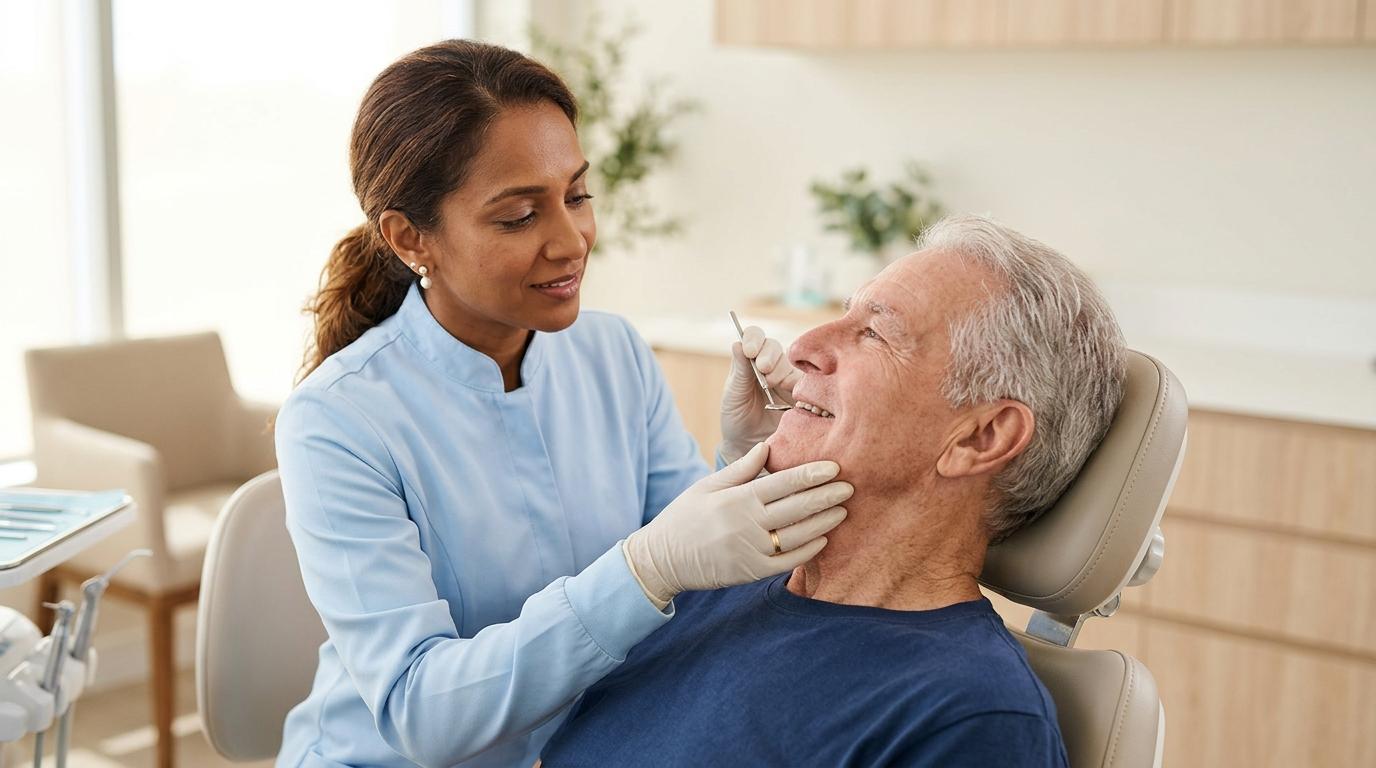
Short answer: Every proper dental check-up includes a quick, painless look and feel of your mouth, lips, tongue, cheeks, gums and the lymph nodes in your neck. The dentist is checking for ulcers, white or red patches, lumps and numbness that could point to something more serious. Most findings are harmless, but a sore that hasn't healed in three weeks, a persistent patch, or a new lump should always be checked. A dentist screens and refers a biopsy and a specialist confirm any diagnosis.
November is Movember, and while most of the conversation is rightly about mental health and prostate and testicular cancer, it's also a sensible time to talk about a type of cancer men are disproportionately affected by and that a dentist is often the first person to spot: mouth and oropharyngeal cancer. This isn't a scare campaign. It's a calm, practical explanation of what actually happens during the soft-tissue check at your dental exam, what's worth mentioning to your dentist, and what the next steps look like if something needs a closer look.
What does the dentist actually check during an oral cancer screening?
It's not a separate appointment or an add-on fee it's built into a normal check-up. Inspection for oral cancer includes direct visualisation and palpation of the mucosa of the oral cavity and external lip, as well as palpation of the head and neck lymph nodes, and should occur annually as part of a comprehensive examination. In plain terms, the dentist will:
Look at your lips, the inside of your cheeks, your gums, the roof and floor of your mouth, and your tongue (including underneath it) under bright light
Gently feel your jaw, the floor of your mouth and your neck for lumps, swelling or thickening
Ask about any changes you've noticed, including numbness, pain when swallowing, or a voice change
Screening for oral cancer should be part of any oral examination, and preventive programs encouraging oral cancer screening and risk minimisation are advocated by the Australian Dental Association. It takes a couple of minutes and happens alongside the usual check of your teeth and gums it's genuinely routine, not something to be anxious about.
If you haven't had a proper check-up in a while, our guide to how often should you really visit the dentist and the importance of regular dental check-ups cover why this soft-tissue check tends to get missed when people only come in for pain.
What counts as a mouth ulcer that won't heal?
Almost everyone gets a mouth ulcer at some point from biting your cheek, a sharp bit of food, braces rubbing, stress or a run-down immune system. The overwhelming majority heal by themselves within one to two weeks and need nothing more than salt-water rinses and time.
The rule of thumb worth knowing is simple: if an ulcer or sore spot is still there after three weeks, it's time to get it looked at. That doesn't mean something is wrong most three-week-old ulcers still turn out to be ordinary ulcers that have just taken longer than usual, or signs of local irritation like a denture edge or a cracked filling. But a sore that lingers well past the normal healing window is exactly the kind of thing a soft-tissue check is designed to catch early, so there's no good reason to wait and watch for months.
What are the other warning signs worth acting on?
Alongside a non-healing ulcer, there are a handful of other changes worth mentioning to your dentist rather than ignoring:
A white patch in the mouth that won't wipe away (sometimes called leukoplakia)
A red patch, especially one that's velvety or doesn't fade (erythroplakia)
A lump or thickening anywhere in the mouth, lip, or in the neck or jaw
Numbness in the lip, tongue or part of the mouth that isn't explained by dental anaesthetic
Persistent difficulty or pain swallowing, or a voice change that doesn't settle
In the mouth, oral cancer most commonly starts as a painless red or white patch that thickens, gets ulcerated and continues to grow, while on the lips it commonly looks like a persistent crusting ulcer that doesn't heal and slowly grows. Other symptoms may include difficult or painful swallowing, new lumps or bumps in the neck, a swelling in the mouth, or a feeling of numbness in the mouth or lips.
It's worth repeating: having one of these signs does not mean you have cancer. Ulcers, fungal infections, gum irritation and benign cysts are all far more common explanations. These symptoms do not automatically mean cancer many oral changes have other explanations however, persistent or unexplained changes should not be ignored. The reason these signs get flagged is simply that early-stage changes are often painless and easy to dismiss, which is why a second set of trained eyes matters.
What actually raises the risk of mouth cancer?
Risk factors are worth knowing honestly, without drama. High risk factors for oral and oropharyngeal cancer include tobacco and alcohol use, betel quid chewing and chronic human papilloma virus (HPV) infection, and sun exposure is a high-risk factor for lip cancer.
Breaking that down with Australian figures:
Tobacco is the single biggest factor. Around 59% of mouth cancers in Australia are caused by smoking.
Alcohol matters on its own and compounds tobacco's effect. Around 31% of mouth cancers are caused by excess alcohol consumption. The two main risk factors for mouth cancer are alcohol and tobacco use, and the combined effect of drinking and smoking is far greater.
Vaping is newer territory, and the long-term data is still catching up, but it's not a free pass — our vaping and teeth article covers what's currently known about vaping and oral tissue.
HPV, particularly type 16, is increasingly linked to cancers at the back of the mouth and throat, separate from the tobacco-and-alcohol pathway.
Sun exposure on the lips is a distinct risk factor for lip cancer, which is one reason lip balm with SPF is worth considering if you spend a lot of time outdoors relevant for plenty of Perth summers.
Age and sex: mouth cancer risk increases as you get older, and men are three times more likely than women to develop the disease part of why this is a fitting Movember topic.
None of this is about assigning blame. It's about knowing where you sit so you can mention it to your dentist, who can factor it into how closely your mouth gets checked.
What happens if the dentist finds something?
This is the part worth being precise about. A dentist's role is to screen and refer not to diagnose. If something looks worth a closer look, the usual next steps are:
Monitoring, if the change is mild and has an obvious, harmless explanation (like a denture rubbing) your dentist may ask you back in a couple of weeks to check it's settling.
Referral to an oral medicine specialist, oral and maxillofacial surgeon, or your GP, if the change doesn't have an obvious cause or hasn't resolved.
A biopsy, carried out by the specialist, which is the only way to actually confirm whether a lesion is cancerous. A biopsy is the removal of a small amount of tissue which is sent to a pathologist to determine if cancer cells are present.
A referral is not a diagnosis, and most referrals from a routine dental check-up turn out to be nothing sinister. The point of the soft-tissue check isn't to alarm people it's to make sure that, on the rare occasion something does need attention, it gets found while it's small and straightforward rather than months later.
Does this cost extra, and what's included in a normal check-up?
No the soft-tissue check is simply part of a standard exam, not a separate service or a dedicated "cancer screening" appointment. In Perth, a routine check-up and clean typically runs somewhere in the range of $180–$320 AUD, depending on what's involved (X-rays, amount of cleaning needed, and so on). This is a guide only your dentist will give you a written quote after your exam, once they can see exactly what you need. Fee ranges across Australia vary by clinic and are broadly reflected in the Australian Dental Association's national fee survey context, rather than a single fixed price. For a full cost breakdown, see our guide on dental check-up and clean cost in Perth.
You can see what's included in a standard visit on our check-ups and cleaning page.
Where to get checked in Perth
If you're after a straightforward, unhurried check-up in Perth's north where the soft-tissue check is simply part of doing the job properly, Hocking Dental Care offers general and family dentistry, check-ups and cleans, children's dentistry and laser dentistry. It's a practical option for families who want one clinic that covers routine exams for every age group without needing to be referred elsewhere for the basics. You can find their details and book directly via Hocking Dental Care.
While you're being thorough about your mouth, it's also worth knowing that persistent bad breath can be a sign of other issues worth raising at the same visit our guide on what causes bad breath explains more.
Ready to book? You can arrange a check-up through Dental Appointments.
FAQ
Is oral cancer screening a separate appointment? No. Oral cancer screening is included as a standard part of every routine dental check-up, with no separate fee for the screening itself. It's a few extra minutes of looking and feeling, not a dedicated service.
How long should I wait before getting a mouth ulcer checked? Most ulcers heal within one to two weeks on their own. If an ulcer is still there after three weeks, get it checked not because it's likely to be serious, but because that's the point at which it's worth ruling things out rather than waiting further.
Can a dentist diagnose mouth cancer? No. A dentist can spot something that looks unusual and refer you on. Only a biopsy, where tissue is removed and sent to a pathologist, can confirm whether cancer cells are present. Diagnosis sits with a specialist, not the dental chair.
What are the main risk factors for mouth cancer? The main risk factors are tobacco and alcohol use, betel quid chewing, chronic HPV infection, and for lip cancer specifically sun exposure. Risk increases with age, and men are affected more often than women.
Does vaping carry the same risk as smoking? The long-term research on vaping and oral cancer risk is still developing, so it's too early to say it carries identical risk to smoking. It's not considered risk-free for oral tissue either — see our vaping and teeth article for what's currently understood.
I don't have any symptoms do I still need to be checked? Yes. Early changes are frequently painless, which is exactly why the check happens as standard at every exam rather than only when something hurts. All people are encouraged and supported to have an annual oral cancer screening as part of their routine dental visit.
This article is general information for Perth readers and isn't a substitute for individual advice. A dental check-up can screen for changes worth investigating, but only a specialist examination and biopsy can confirm a diagnosis.