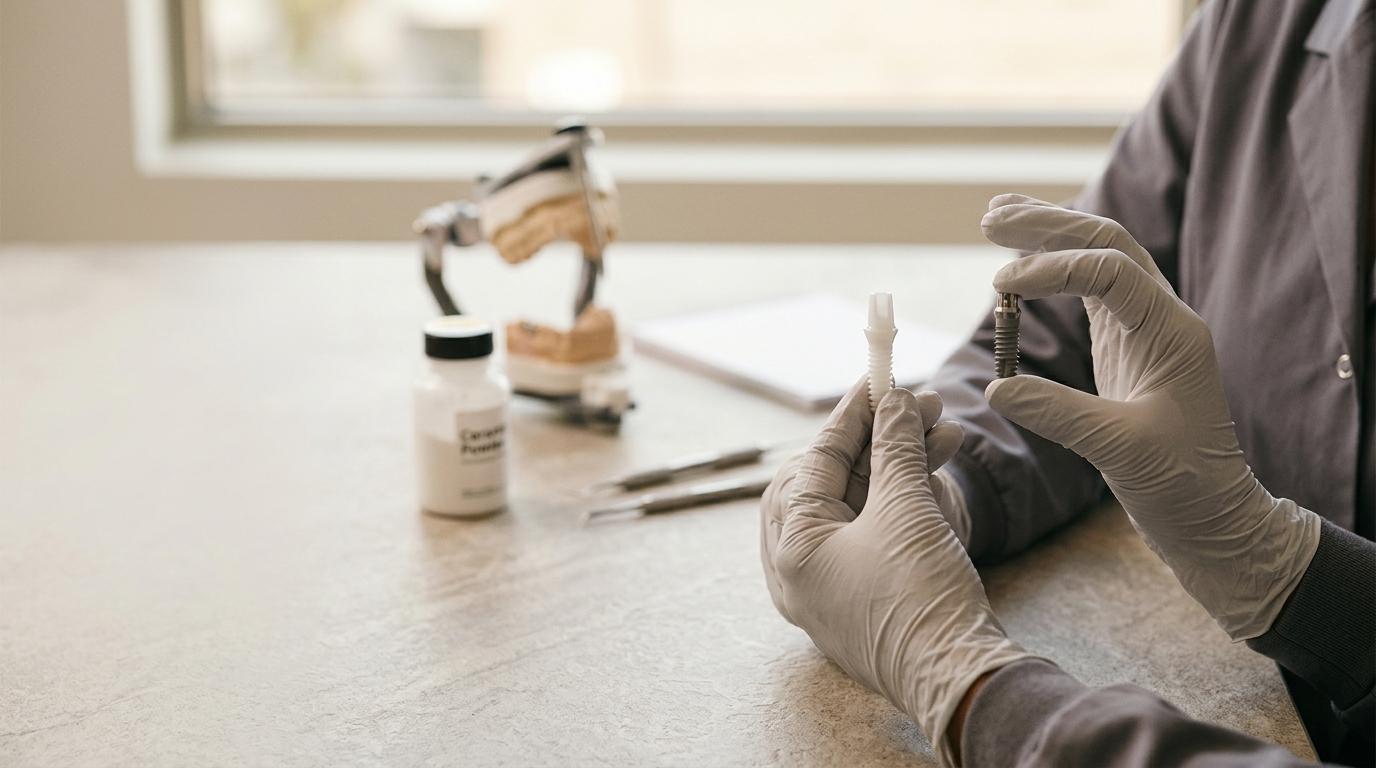
Short answer: Titanium is the long-established, default implant material, backed by decades of data and a five-year survival rate around 97%. Zirconia is a newer, metal-free, tooth-coloured alternative that can look more natural at the gumline and suits patients who specifically want a metal-free implant or have a confirmed metal sensitivity, but it has a shorter track record and fewer restorative options. True titanium allergy is rare. The right choice depends on your gum type, bite, budget and what a specific Perth clinic actually offers, confirmed at an in-person exam.
What's the actual difference between titanium and zirconia implants?
Both materials do the same basic job: a small post is placed in the jawbone to replace a tooth root, then a crown, bridge or denture is attached on top. The difference is what the post is made from.
Titanium implants are made from commercially pure titanium or a titanium alloy. They've been the standard implant material since the 1960s, and most of what we know about implant success, failure and long-term maintenance comes from titanium studies. Zirconia implants are made from a ceramic (zirconium dioxide) rather than a metal. Ceramic dental implants are a relatively new type of dental implant made from the ceramic material zirconia, and unlike traditional titanium implants, they have a whitish colour, which is the main reason patients ask about them.
For the full step-by-step of what happens between consultation and final crown, our dental implants Perth cost guide covers that process in detail rather than repeating it here.
Which material has the longer track record?
Titanium, by a wide margin. Over the past four decades, titanium has often been considered the material of choice for dental implants due to its high survival rate (97.2% at 5 years and 95.2% at 10 years), coupled with biocompatibility, low corrosion and high strength. That's why titanium implants still remain the gold standard in clinical practice, even as zirconia is increasingly considered a relevant complement to it.
Zirconia's data set is smaller and more variable. Some reviews looking at longer follow-up periods found zirconia success rates ranging from 57.5 to 93.3% over 12–80 months of follow-up following loading, which is a wider spread than titanium typically shows. Other, shorter trials comparing the two materials directly have found no meaningful difference in bone levels after one to three years of loading. It's fair to say zirconia performs well in the studies done so far, but there simply isn't the 20- and 30-year data that exists for titanium yet.
Does zirconia really look better at the gumline?
In some cases, yes, particularly for people with thin gums or a high smile line. The concern with titanium is that a thin gum can occasionally let a faint grey shadow show through at the gumline over time. In such cases, the hint of grey titanium in combination with a high smile line is an aesthetic letdown. Zirconia's tooth-like colour avoids that specific issue, which is part of why aesthetic considerations, particularly in patients with a thin peri-implant soft tissue phenotype, are one reason some patients choose zirconia.
That said, aesthetics at the gumline also depend heavily on the skill of the crown and gum work on top of the implant, not the implant material alone. A well-placed titanium implant with a good crown and healthy gum thickness can still look excellent. This is a genuine point in zirconia's favour for a specific group of patients, not a reason to assume titanium will look obviously artificial.
If I have a metal sensitivity, do I need zirconia?
Possibly, but a confirmed titanium allergy is uncommon. Some case reports have suggested titanium hypersensitivity might result in implant failure, and another study found a minority of the population may show immunologic reactions to titanium. It's a real, documented phenomenon, but it affects a small proportion of patients, and symptoms such as unexplained inflammation or a failing implant should be properly investigated rather than assumed.
Zirconia is the obvious option if you want to rule metal out entirely. Zirconia implants offer the solution for patients requesting a complete metal-free restoration, and some patients choose it purely on preference rather than a diagnosed allergy. If you suspect a genuine metal sensitivity, that's a conversation to have with your dentist or GP before committing to either material, since skin patch testing and medical history matter more than guesswork.
One-piece or two-piece: why does implant design matter?
This is one of the more practical differences between the two materials. Titanium implants are almost always two-piece: a separate post and abutment that can be adjusted, angled and restored flexibly after the post has healed in the bone. Zirconia implants were originally only available as one-piece designs, where the post and abutment are a single fused unit shaped above the gum at the time of surgery.
A one-piece zirconia implant has been reported to be twice as resistant to fracture as a two-piece design, which is one reason the one-piece style has remained common. However, two-piece zirconia designs are now also widely used, giving more flexibility than in the past. Even so, the range of connectors, abutment angles and crown attachment options for zirconia is still narrower than the titanium catalogue most labs and clinics work with every day. For a single front tooth, our guide to single tooth implant cost and what to expect walks through how the post, abutment and crown stages fit together regardless of material.
For larger cases, such as replacing a full arch, titanium's two-piece flexibility and decades of use in systems like All-on-4 is why it remains the default material for that kind of treatment.
How much more does a zirconia implant cost in Perth?
Prices vary by clinic, case complexity and the exam findings, so any figure here is a guide only a written quote always follows an in-person assessment. As general context, the Australian Dental Association's fee survey work shows a wide spread for implant treatment nationally, with totals commonly sitting somewhere in the low-to-mid thousands per tooth once the post, abutment and crown are all included, and Western Australia tends to sit toward the more affordable end of the national range.
Zirconia implants typically cost more than titanium for the same single-tooth case, often by several hundred to around a thousand dollars extra, because the implant systems, lab components and clinician training are less widely available than for titanium. It's not a small or guaranteed difference it depends entirely on the system used and the clinic's own fee structure, which is why asking for an itemised written quote matters more than any published range. For a broader sense of where implants sit against other treatments, see our overview of dental costs in Perth in 2026. If you're weighing cost against travelling overseas for cheaper treatment, our comparison of dental work in Bali versus Perth is worth reading before you decide, since follow-up care and revisions are harder to manage from a distance.
So, titanium or zirconia — who actually suits each one?
Titanium tends to suit most patients, particularly anyone needing multiple implants, a full-arch solution, or a case where flexibility during the restorative stage matters. It also suits anyone who wants the material with the longest, most consistent evidence behind it.
Zirconia tends to suit a narrower group: patients with a confirmed or strongly suspected titanium sensitivity, patients who want a completely metal-free mouth as a firm preference, and patients with thin gum tissue in a highly visible front-tooth position where a tooth-coloured implant collar is a genuine advantage. It's generally less suited to complex multi-tooth cases, patients who may need adjustments down the track, or anyone prioritising the longest possible evidence trail.
If you're still choosing between implants and other options altogether, our guide comparing dental implants versus dentures sets out that wider decision.
What should I ask a Perth clinic before choosing?
Not every clinic offers both materials, and not every implant system has a zirconia equivalent. Before assuming either option is on the table, ask directly: which implant brands and materials does this clinic place, does the clinic offer one-piece or two-piece zirconia if it offers zirconia at all, and what's included in the written quote.
North Beach Dental is a good example of a Perth clinic to have this conversation with, since dental implants sit within their broader restorative range alongside cosmetic dentistry, porcelain veneers, All-on-4, root canal treatment and dentures. Their team can talk through what's clinically suitable for your bite, gum thickness and bone levels, and what materials and systems they actually use, rather than assuming a particular material is available. You can find their details on the North Beach Dental clinic page, or browse the broader dental implants treatment page for general background before you go in.
FAQ
Is zirconia better than titanium?
Neither material is universally "better." Titanium has the longer track record and the most restorative flexibility, while zirconia offers a metal-free option with tooth-like colour that can suit thin gums or a confirmed metal sensitivity. The right choice depends on your individual case.
How common is a true titanium allergy?
Uncommon. A minority of the population may show immunologic reactions to titanium, but most sensitivity concerns turn out to be unrelated inflammation rather than a confirmed allergy. Proper testing, not assumption, is the way to confirm it.
Can zirconia implants be used for a full arch or All-on-4?
Titanium remains the standard for All-on-4 and other full-arch work because of its two-piece flexibility and longer evidence base in that setting. Ask your clinic directly whether a zirconia full-arch option exists before assuming it does.
Does a zirconia implant cost more in Perth?
Usually yes, though the exact gap depends on the system and clinic. Treat any published figure as a starting guide only — a written, itemised quote after your exam is the only reliable number.
Will a zirconia implant definitely look more natural than titanium?
Not necessarily. It can help in thin-gum, highly visible cases, but overall appearance also depends on the crown and surrounding gum work, not the implant material alone. No outcome can be guaranteed before an exam.
Should I ask my dentist which material they recommend for me?
Yes. Bring your gum type, bite, any suspected metal sensitivity and your budget to the conversation, and ask for the reasoning behind their recommendation along with a written quote.
This article is general information, not a treatment recommendation. Every case is different, and a written quote follows a proper dental exam. Ready to talk it through? Book an appointment to discuss which material suits your case.