Short answer: All-on-4 replaces a full upper or lower arch of failing or missing teeth using four implants and a fixed bridge. For Mullaloo, Iluka, Burns Beach and Ocean Reef patients, the process always starts with a consult and a CT (CBCT) scan, because bone volume, gum health, sinus position and bite are what actually decide candidacy - not a quiz or a phone call. Mullaloo Beach Dental runs this assessment locally before any written quote is given, and treatment then happens in stages over several visits.
What happens at the first all-on-4 consult?
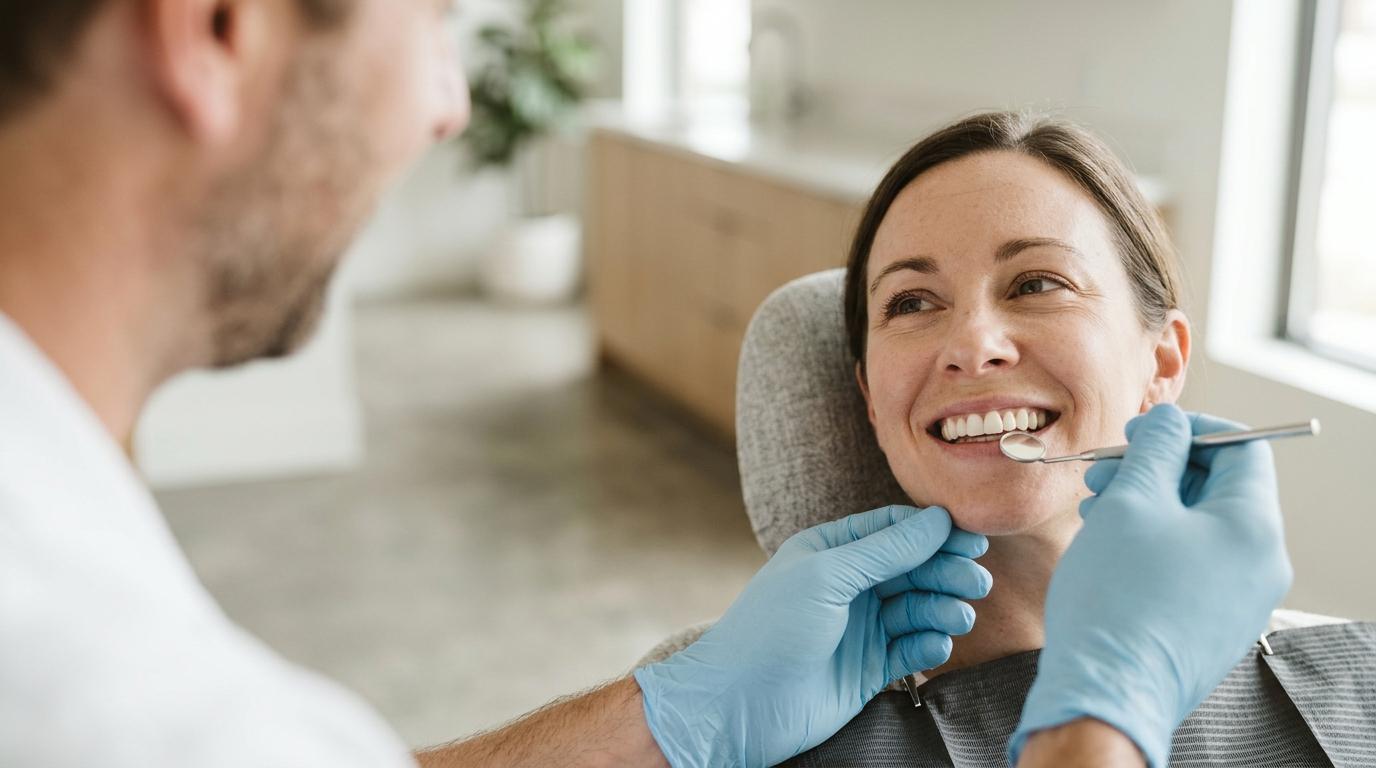
The first appointment is a conversation and an exam, not a sales pitch. The dentist will go through your dental and medical history, look at the teeth and gums you currently have, take photos, and ask what's bothering you - loose teeth, a denture that won't sit still, repeated breakages, or years of patchwork dentistry that's finally catching up.
At this stage, the dentist is building a picture of whether full-arch implants are even the right conversation to be having, or whether something less involved (a bridge, an implant-retained denture, or simple restorative work) might solve the problem instead. If you want to compare those options side by side before you commit to anything, this guide to dental implants vs dentures is a useful starting point, as is this overview of implant-retained dentures, which sit between a traditional denture and a fixed full-arch bridge.
If full-arch implants look like a reasonable path, the next step is imaging - typically a 2D scan on the day, followed by a dedicated CT appointment.
Why does the CT scan matter so much?
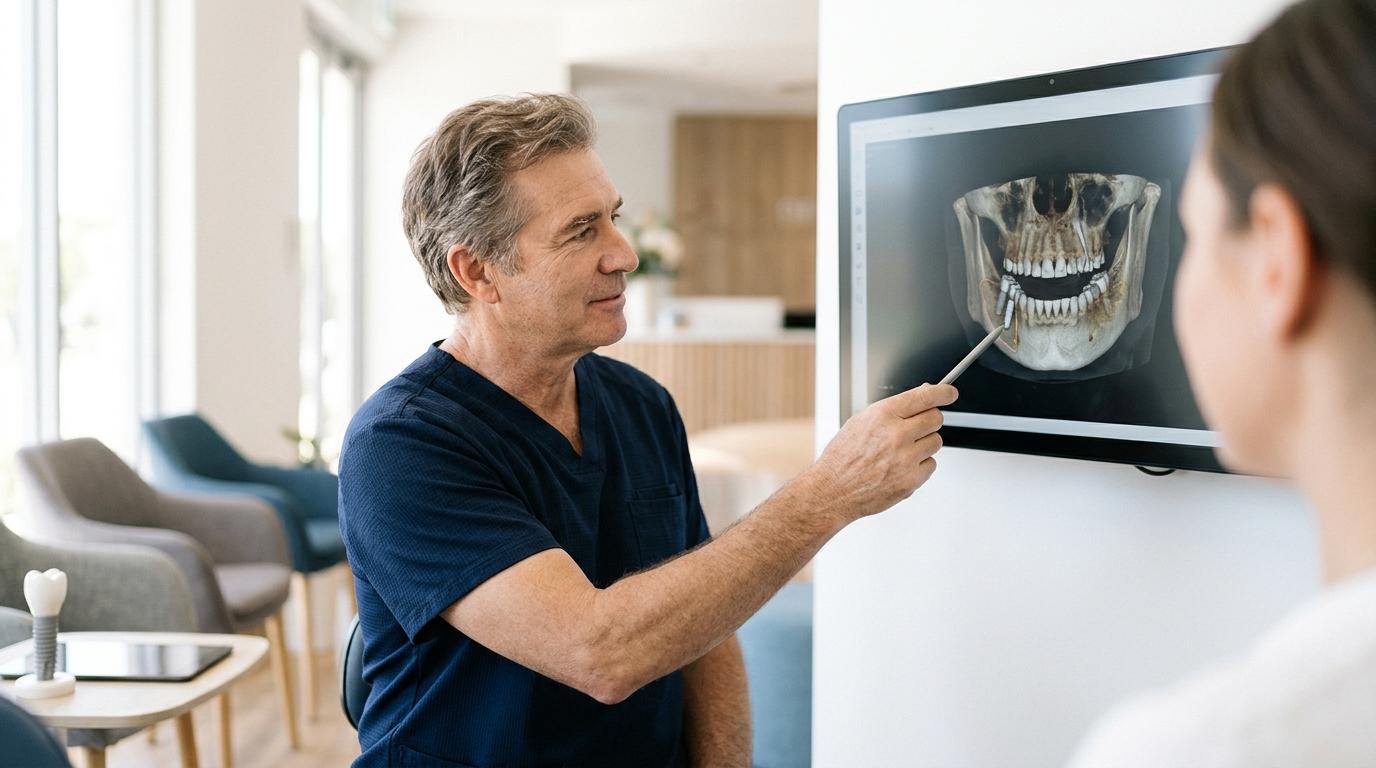
A CT (or CBCT) scan gives a 3D view of your jaw - bone volume, bone density, the position of nerves and sinuses, and how much structure is actually available to anchor implants. This is the detail a visual exam or a standard X-ray can't give you.
The longevity and success of the bridge depends heavily on bone quality at each implant site, which makes pre-treatment assessment with CBCT imaging essential. The scan lets the dentist plan implant position and angle before any surgery happens, which is part of why All-on-4 was designed the way it was - four strategically angled implants can often be placed which means many patients who lack sufficient bone volume for conventional implants can avoid bone grafting altogether.
That said, the scan can also show the opposite that bone loss is more extensive than it looks from the outside, or that a sinus sits closer to the planned implant site than expected. That's not a failure of the appointment; it's the scan doing its job. It's also why no dentist can honestly tell you "yes, you're a candidate" before they've seen it.
Am I a candidate for all-on-4?
This is the question most people searching "am i a candidate for all on 4" actually want answered, and the honest version is: the CT scan and clinical exam decide it, not a checklist. But there are general factors a dentist will weigh up during that assessment.
Patients with badly decayed, broken, or failing teeth across most of an arch are often the ones considering it in the first place. Patients with badly decayed teeth, broken down teeth, or teeth severely impacted from gum disease are often good candidates for all-on-4 treatment. One of the appeals of the technique is that it was built to work around some of the barriers that rule people out of simpler implant options - all-on-4 can be performed on patients who would normally be ineligible for dental implants due to diabetes, osteoporosis, or other health conditions, and patients who lack the bone density to support a large number of dental implants may be ideal candidates.
Other things that come into the conversation include smoking status, how well any existing gum disease is controlled, medications that affect bone or wound healing, and your bite and jaw relationship. None of these automatically rule someone in or out - they're part of what the scan and exam are weighing up together. If you're not sure where you stand, it's worth reading the broader explainer on all-on-4 dental implants in Perth, cost and process before you book, just to arrive with realistic expectations.
What's the staged timeline for full-arch implants?
All-on-4 isn't a single appointment - it's a staged process, usually something like this:
Consult and initial exam - history, goals, a look at your current teeth and gums.
CT scan and treatment planning - the 3D imaging that maps bone, nerves and sinuses.
Written quote - once the dentist has the scan, you get an itemised plan and price.
Preparation, if needed - extractions or other work to get the mouth ready.
Surgical placement day - four implants are placed and a fixed temporary bridge is fitted the same day in most cases.
Healing period - implants fuse with the jawbone through a process called osseointegration. After the implants are placed, your jawbone adheres itself to the implants through a process called osseointegration. This is a biological healing process, and the timeframe depends on your own bone and health rather than the clinic's booking calendar.
Final bridge fitting - the temporary acrylic bridge is eventually swapped for a more permanent one. As a guideline, this fixed bridge lasts between three to five years before needing replacement, and many patients choose to replace the initial fixed bridge with a long-term restorative solution made of zirconia or porcelain.
Every one of these stages depends on what the scan and exam actually show for your mouth, so treat any timeline you're given before that point as a rough guide rather than a promise.
How much do all-on-4 implants cost in Perth?
Full-arch implant pricing varies enormously depending on bone grafting needs, the number of implants, materials, and whether sedation or hospital fees apply. As a broad guide, a full-mouth solution using All-on-4 or All-on-6 can cost anywhere from $20,000 to $40,000 per arch in the Australian market, and figures reported in Australian Dental Association fee survey data have shown a similarly wide spread between the lowest and highest recorded cases. The Australian Dental Association (ADA) surveys dental practitioners to provide average price data on more than 120 dental treatments each year, which is why dentists reference this data as context rather than quote a single fixed figure - fees genuinely differ between practices, cases and clinicians.
Treat any number you see online, including the ranges above, as a guide only. A proper written quote only follows your CT scan and exam, because that's what tells the dentist how many implants you actually need, whether grafting is required, and which bridge material suits your bite. Private health fund rebates on full-arch work are typically modest relative to the total cost, so it's worth checking your policy's Major Dental limits before you budget.
What should I bring to a quote appointment?
Once you've had your consult and CT scan, you'll usually be booked in for a dedicated appointment to go through your written, itemised quote. To make that visit useful, bring:
Photo ID and your Medicare or DVA card if applicable.
Your private health fund card and a note of your Major Dental and annual limits.
A list of current medications and any relevant medical conditions (diabetes, osteoporosis, blood thinners, smoking history).
Existing dentures, splints or night guards, if you wear any.
Any previous dental X-rays or scans from other practices.
A written list of questions - about materials, the temporary bridge, maintenance, and what happens if a problem comes up during healing.
A realistic sense of your budget and payment preferences, so the quote can be discussed against what's actually workable for you.
This is also the appointment to ask how the quote breaks down - implants, the temporary bridge, the final bridge, reviews, and any extractions or grafting - rather than accepting a single bottom-line number.
Why Mullaloo Beach Dental for Mullaloo, Iluka, Burns Beach and Ocean Reef patients?
Mullaloo Beach Dental sits at 19A Koorana Road, Mullaloo, within easy reach of Iluka, Burns Beach, Ocean Reef, Kallaroo, Hillarys, Whitfords and Padbury. The Mullaloo Beach clinic offers premium dental care with ocean views, combining a relaxing beachside atmosphere with advanced dental technology for exceptional results.
Beyond full-arch implant work, the practice covers general and family dentistry, crowns, veneers, Invisalign, dentures, sleep dentistry and laser dentistry, with digital technology used through the assessment and planning process - see the digital dentistry page for more on how that imaging fits into implant planning generally, and the main dental implants treatment page for an overview of options beyond All-on-4.
If you're coming from further along the coast, these local guides may also help: dentist Iluka and Burns Beach, your closest local dental clinic and dentist Ocean Reef, Kingsley, Padbury and Heathridge, both covering the same practice from a broader northern-suburbs angle.
To check the clinic's current details or book a consult, visit the Mullaloo Beach Dental clinic page, or go straight to booking an appointment online.
FAQs
How long does the first all-on-4 consult take? It varies by case, but expect a thorough conversation plus an exam of your current teeth and gums. If imaging is needed, that may happen on the same visit or be booked separately - the clinic can confirm this when you book.
Does the CT scan cost extra on top of the consult? Often yes, CT/CBCT imaging is typically a separate item from the consult fee. Ask about this when you book so there are no surprises, and remember any price discussed before the scan is a guide only.
Can I get all-on-4 if I already wear a full denture? Possibly - many people move to All-on-4 after years of denture frustration. Whether it's the right fit depends on your jawbone, which the CT scan will show. If a fixed bridge isn't suitable, an implant-retained denture may be worth discussing instead.
What's the difference between all-on-4 and implant-retained dentures? All-on-4 is fixed in place and isn't removed by the patient; implant-retained dentures typically clip onto implants and can be taken out for cleaning. This comparison of implants vs dentures covers the practical differences in more depth.
Will my health fund cover much of the cost? Usually only a modest portion. Major Dental limits on most extras policies are relatively low compared with full-arch pricing, so check your specific policy and ask the clinic for an itemised quote you can take to your fund.
What if the scan shows I'm not a good candidate right now? That's a genuine possible outcome, not a failure of the process. The dentist may suggest preparatory work, a different implant approach, or an alternative tooth-replacement option entirely - the scan and exam exist precisely to make that call accurately, rather than guessing beforehand.